
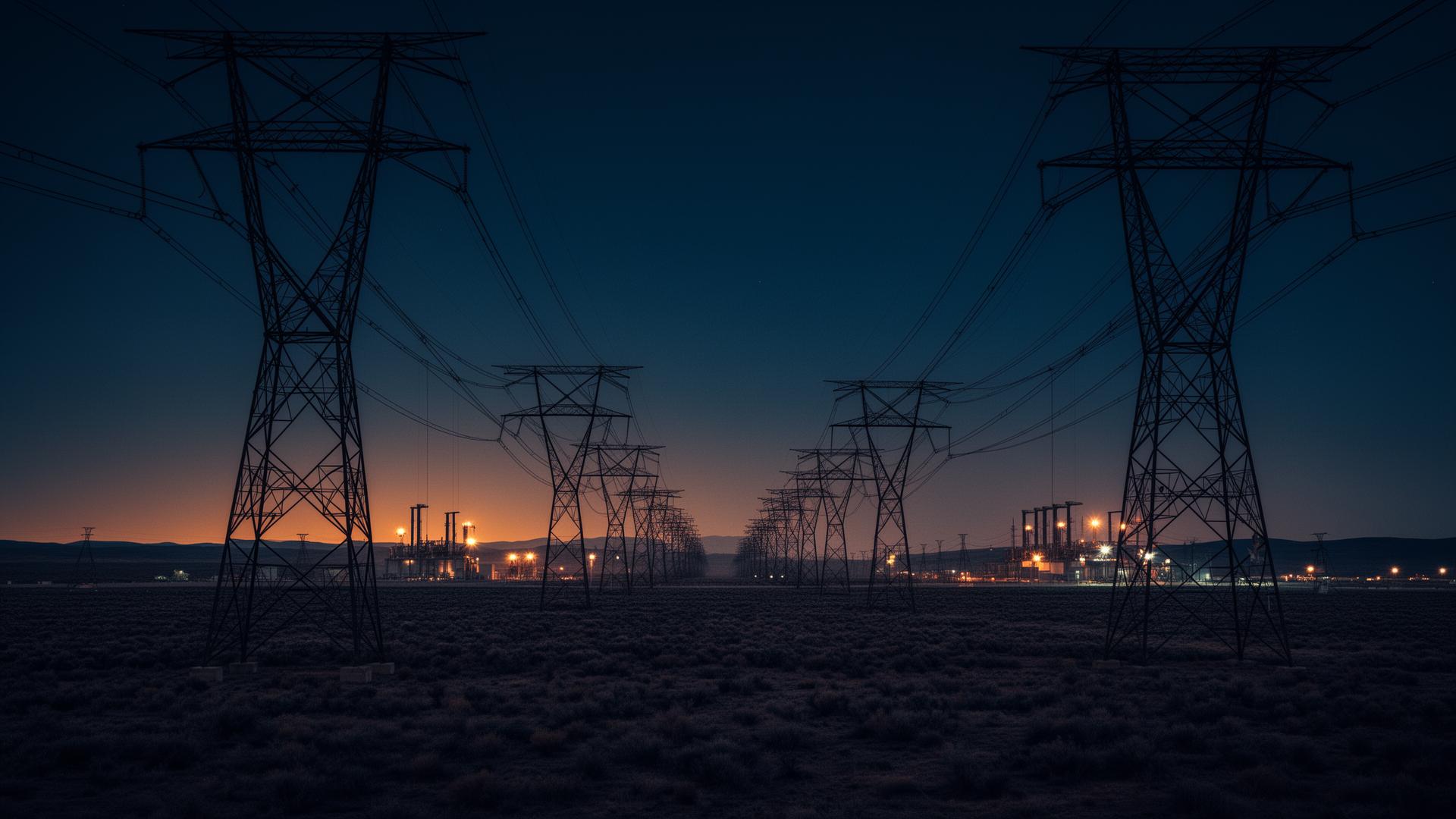
HVDC Corridors and the Stranded-Renewables Problem
Wind in the plains, solar in the desert, load on the coasts. Why long-distance transmission is the bottleneck of the decade.
The wind in western Kansas is some of the most consistent in the Western Hemisphere. Capacity factors above 50 percent are achievable across the High Plains from Texas to the Dakotas — generation assets that any serious grid planner would classify as exceptional. The solar irradiance in the Sonoran Desert exceeds most of Southern Europe. By resource metrics alone, the United States possesses renewable energy potential that dwarfs its entire foreseeable demand.
None of that electricity reaches New York City, Boston, Chicago, or the data center corridors of Northern Virginia without a wire.
The wire problem is not new, but it has become the defining constraint of the modern energy buildout. The United States has spent the last two decades dramatically improving generation technology — solar costs down 97 percent, wind turbines taller and more efficient, batteries scaling at a pace that rivals semiconductor deployment. The grid that is supposed to transmit the output of that generation has not kept up.
The result is a system under compound stress: renewable resources stranded far from load centers, interconnection queues drowning in projects the existing grid cannot absorb, curtailment rising as solar and wind generation exceeds local delivery capacity, and congestion costs accumulating across every major market region. And now, layered on top of that existing infrastructure deficit, a demand surge from AI data centers, electrification, and reshored manufacturing is arriving faster than any utility planning cycle anticipated.
High-voltage direct current transmission — HVDC — is emerging as the infrastructure technology that the modern grid most critically needs and least reliably gets built. The physics are compelling. The economics are increasingly supportive. The impediments are substantial in ways that have nothing to do with engineering.
The Geography Problem
The United States is not arranged conveniently for electricity delivery.
The largest electricity demand centers — the Northeast megalopolis from Boston to Washington, coastal California, the greater Chicago region, the Texas Triangle — are located at the edges or in regions with limited renewable resource quality. The best renewable resources are located in places where relatively few people live.
U.S. resource zones vs load centers
The 1,000-mile gap between renewable supply and metropolitan demand. Wind belt, desert solar, and the coasts that consume the power.
The wind resource in MISO's central region — spanning Iowa, Illinois, Minnesota, and the Dakotas — is extraordinary. Capacity factors of 45 to 55 percent for modern tall turbines are achievable across broad geographic areas. The offshore Atlantic wind resource, while more accessible to coastal load centers, comes with its own cost and logistics complexity. The Great Plains wind belt, stretching from the Texas Panhandle to southern Canada, represents a generation resource whose theoretical output could supply a substantial fraction of U.S. electricity demand.
Texas understood this early. ERCOT built the Competitive Renewable Energy Zone transmission program — over 3,500 miles of new transmission lines connecting West Texas and Panhandle wind to the Dallas-Fort Worth, Houston, and Austin load centers — through a state-level planning and cost-socialization process that has no real equivalent elsewhere in the country. Texas solved its wind-to-load transmission problem because ERCOT is a single-state ISO with a relatively unified regulatory structure and a legislature that was willing to socialize transmission costs across ratepayers. The rest of the country does not have that advantage.
The solar story has the same geographic structure. The Sonoran Desert, the Mojave, and the Four Corners region of the Southwest host some of the highest-quality solar irradiance on Earth. But the major California load centers — Los Angeles, the Bay Area, San Diego — are separated from the best desert solar resources by mountain ranges and existing transmission constraints. Phoenix and Tucson are not major load centers. Las Vegas is large but not by coastal standards. The solar resource is real. The wire to deliver it is insufficient.
The fundamental grid geography problem is this: generation and load are disconnected by hundreds to thousands of miles, and the existing transmission system was not designed to bridge that gap at bulk-power scale.
Why AC Transmission Breaks Down at Distance
The transmission grid that connects generation to load in the United States is overwhelmingly alternating current. AC power has been the foundation of electrical infrastructure since the early twentieth century because AC voltage can be stepped up and down with transformers, enabling efficient long-distance transmission at high voltages followed by step-down to usable distribution voltages.
AC systems work well for regional grids. They were designed for regional grids. When you try to push bulk power across continental distances, the physics become challenging in ways that are not always intuitive.
Reactive power and line charging. AC transmission lines are not just resistors — they are also capacitors and inductors. Long AC lines generate reactive power that must be managed continuously to maintain voltage stability. At long distances, the reactive power requirements of the line itself begin to consume a significant fraction of the line's capacity and create voltage regulation problems that require expensive compensation equipment — shunt reactors, static VAR compensators, synchronous condensers — placed at multiple points along the route.
Stability constraints. AC systems must remain synchronized — all generators across an interconnected system must maintain the same frequency with minimal phase angle difference. As transmission distances increase, the synchronizing torques that hold generators in step become weaker. Long AC corridors can develop stability limits that are lower than their thermal capacity — meaning the line can physically carry more current than it is allowed to transmit for stability reasons. The stability limit, not the thermal limit, becomes the binding constraint.
Loop flows. Power flowing on an AC grid does not take the path you specify. It takes all available parallel paths simultaneously, weighted by impedance. If you contract to move power from a wind farm in Iowa to a load center in Illinois, some of that power may flow through Wisconsin, Michigan, Indiana, and Ohio before arriving at the destination — loading transmission infrastructure in states that did not plan for it and creating congestion on lines that are already utilized for regional flows. This is called loop flow, and it is the source of significant ongoing conflict among ISOs in the Eastern Interconnection.
Losses. All transmission lines experience resistive losses — power dissipated as heat as current flows through the conductor. At high voltage, losses are lower (power loss scales with the square of current, and higher voltage means lower current for the same power). But AC lines also experience losses from charging currents and skin effects that accumulate over long distances. A 1,000-mile AC line moving bulk power incurs losses that measurably reduce the delivered energy compared to the generated energy.
None of these problems make long-distance AC transmission impossible. They make it expensive, complex, and capacity-limited in ways that become increasingly constraining as the transmission distances required by renewable geography grow.
HVAC vs HVDC transmission losses
Delivered-energy loss as a function of corridor length. DC line losses cross below AC near 600 miles overhead — and below 300 miles for cables — once reactive compensation and charging effects are included.
Why HVDC Changes the Physics
High-voltage direct current transmission converts AC power to DC at one end — the rectifier station — transmits DC power at high voltage over the line, and converts back to AC at the other end — the inverter station. The two terminals can be at any voltage level, frequency, or phase angle. The DC link between them is indifferent to AC system characteristics at either end.
This physical fact opens a set of capabilities that AC transmission cannot replicate.
No reactive power on the line. A DC line does not generate or consume reactive power during transmission. The line is purely resistive from a power flow perspective. Voltage stability along the corridor is a function only of DC voltage regulation, which is controlled by the converter stations. Long-distance DC lines do not require intermediate reactive power compensation, eliminating a major cost and reliability concern of long-distance AC.
Controllable power flows. DC power flow is fully controllable at the converter stations. Operators can direct exactly how many megawatts flow over the DC link, regardless of what the AC system is doing on either side. This eliminates loop flow problems entirely — power moves where it is sent, not where impedance paths happen to take it. For interregional transmission, this is a transformative advantage. A DC interconnection between MISO and PJM can be scheduled precisely, with no impact on AC flows within either system.
Asynchronous interconnection. Because DC transmission decouples the AC systems at each end, it enables connection between grids that operate independently. The Eastern and Western Interconnections in the United States are not synchronized — they operate at nominally the same frequency but are not electrically coupled. The only connections between them are back-to-back DC converters at a handful of locations: the Lamar, Colorado; Stegall, Nebraska; and Miles City, Montana DC ties. Each has limited capacity. A large HVDC line between the Western Interconnection's desert solar resources and the Eastern Interconnection's load centers would cross this asynchronous boundary seamlessly — something no AC line can do without complex and expensive machinery.
Lower losses over long distances. DC transmission loses power only to resistive losses in the conductor. Over distances above roughly 500 to 600 miles overhead (300 miles underground), DC losses become lower than the equivalent AC line, which faces resistive losses plus charging current losses plus reactive compensation costs. At 1,000+ mile distances — which are common for true continent-scale renewable delivery — the loss advantage of DC is substantial and economically significant.
Underground and subsea capability. AC cables underground or undersea generate extremely high charging currents that make long-distance AC cables impractical beyond roughly 30 to 50 miles for AC. DC cables do not have this problem. Subsea HVDC links of 600+ miles are in commercial operation in Europe. Underground HVDC cables are technically feasible for long-distance applications where overhead rights-of-way are unavailable — a significant advantage in developed corridors where overhead transmission faces intense opposition.
Grid support capabilities. Modern voltage-source converter (VSC) HVDC systems — the technology used in projects built since approximately 2010 — can provide reactive power support to the connected AC grid, participate in frequency regulation, and in some configurations provide black start capability. These are operational benefits that partially compensate for the cost premium of HVDC over AC at equivalent transmission distances.
The physics of HVDC are compelling. The challenge has never been technical feasibility. It has been the cost, complexity, and regulatory difficulty of actually building the infrastructure.
“Generation technology is no longer the constraint. The technology base for a high-renewable electricity system is established, cost-effective, and commercially mature. The constraint is the wire.”
The Interconnection Queue as Symptom
Before examining what the transmission buildout requires, it is worth understanding the specific damage that transmission undersupply is causing to generation investment in the current environment.
The U.S. interconnection queue holds more than 2,600 GW of proposed generation and storage as of 2024. The majority of that capacity — roughly 95 percent by technology mix — is solar, wind, and storage. The transmission system those projects would connect to cannot absorb them.
U.S. interconnection queue growth
Total active capacity in U.S. ISO/RTO queues, GW. The IRA passage and AI load surge have compressed two decades of growth into a vertical wall.
When a generation project applies for grid interconnection, the ISO conducts studies to determine whether the project can connect without violating stability, voltage, or thermal limits on the existing grid. When the existing grid is already close to its capacity limits — as it is across most major solar and wind resource areas — those studies return with large network upgrade cost allocations. The developer must pay for new transmission infrastructure to relieve constraints that their project would otherwise create or worsen.
In regions where the transmission system was not designed for the renewable resource geography, these upgrade costs are frequently enormous. A 300 MW solar project seeking interconnection in a constrained desert corridor might receive a study result assigning $150 to $300 million in network upgrades — costs that would destroy the project's financial viability at any market clearing price achievable in today's capacity markets. The developer withdraws. The interconnection slot is lost. The grid studies for every subsequent project in the queue must be rerun.
Curtailment is the operational manifestation of the same physical constraint. When solar or wind generation exceeds the capacity of the local transmission system to export that power to load centers, the ISO instructs generators to reduce output or stop producing entirely. The generation asset is connected, the sun is shining or the wind is blowing, and the electrons are being discarded because there is no wire to move them to where demand exists.
Renewable curtailment by region
Annual curtailed generation, TWh. Stranded electrons across CAISO, ERCOT, MISO, and SPP — energy that was built but never delivered.
CAISO curtailed over 3 million megawatt-hours in 2023. ERCOT curtails wind at rates that have made negative pricing events — hours when generators pay the grid to take their power — a regular occurrence in West Texas. MISO's wind belt consistently produces more power than the region's load can absorb during high-generation periods, with the excess stuck west of the transmission bottlenecks that separate the wind belt from the Chicago load center and eastern interconnections.
Congestion costs — the price paid to resolve conflicts between power that wants to flow and transmission limits that prevent it — have risen into the billions of dollars annually in PJM, and are growing in every major RTO. These costs represent both direct economic waste and a signal that the transmission system is not matched to the generation mix it is being asked to support.
Annual congestion costs by RTO
$ billions, 2010–2023. Congestion is a tax on inadequate transmission — paid by load and generators alike.
Locational price divergence
Indicative LMP at a high-solar midday hour: generation zones collapse toward negative pricing while coastal load centers remain elevated. The price gap is the bottleneck made visible.
The interconnection queue crisis is fundamentally a transmission crisis. The queue is full because the transmission system cannot absorb what is trying to connect.
The Mega-Corridor Projects
Several large-scale transmission projects are attempting to address the geographic stranding problem. They represent the leading edge of the HVDC buildout — and they illustrate both the potential and the difficulty.
Major HVDC corridors in development
The beginning of a continental grid. These four projects represent the leading edge of U.S. HVDC — and a fraction of what the deficit requires.
SunZia Transmission is a 550-mile, 3,000 MW HVDC line connecting wind resources in New Mexico to Arizona and ultimately California load centers. After more than fifteen years of development and permitting, construction is underway. SunZia will be the largest single wind energy infrastructure project in U.S. history when complete, delivering power across state lines and time zones to Western Interconnection load centers. The project's development timeline — fifteen years from concept to construction start — is a reasonable representation of what large interregional transmission requires in the current regulatory environment.
Grain Belt Express is an 800-mile HVDC line originally proposed to move wind energy from Kansas to load centers in Missouri, Illinois, Indiana, and potentially the PJM market. The project encountered years of opposition from Missouri utility commissions before ultimately receiving approval. Construction is underway on initial segments. Grain Belt illustrates the specific challenge of multi-state HVDC: each state through which the line passes has its own regulatory process, its own utility commission, and its own set of stakeholders with their own objections. A line crossing four states faces four separate regulatory proceedings, with any one capable of blocking the entire project.
SOO Green HVDC Link proposes a 349-mile underground HVDC cable through existing railroad rights-of-way between Iowa and Illinois, avoiding overhead construction and the associated landowner opposition. The underground approach — using existing rail corridors — represents a pragmatic response to surface right-of-way constraints and is being watched closely as a potential model for urban and suburban transmission corridors where overhead lines face intense opposition.
TransWest Express is a 730-mile, 3,000 MW HVDC project crossing Wyoming, Colorado, Utah, and Nevada to connect Wyoming wind resources with Western load centers. The project received a federal right-of-way on Bureau of Land Management land — a significant milestone — and is in advanced development.
These projects are genuinely large infrastructure achievements. SunZia at 3,000 MW is the size of two large nuclear plants or several major solar facilities combined. Grain Belt Express, when complete, will have the capacity to serve the equivalent of several million homes from Kansas wind.
They are also insufficient for the scale of transmission the renewable geography problem requires.
Build timelines: generation vs transmission
Median project development time, years. Solar and storage can be built in two to three years. Large interregional transmission takes a decade or more.
The U.S. would need hundreds of gigawatts of new interregional transmission capacity to fully connect the best renewable resource areas to major load centers, eliminate the curtailment that reflects stranded generation, and absorb the interconnection queue backlog. What is currently proposed and under development is measured in tens of gigawatts. The gap between what is needed and what is being built is the defining metric of the transmission deficit.
AI Load Growth Intensifies the Problem
The transmission system was not designed for simultaneous generation decentralization and load growth acceleration. It is now facing both.
Hyperscale AI data centers represent the most concentrated load growth the U.S. electrical system has absorbed in decades. A single 500 MW campus draws as much power as a mid-sized city, around the clock, every day of the year. Unlike residential or commercial load, data center demand does not flex with time of day or season. It is continuous, high-magnitude, and reliability-sensitive.
The geographic distribution of hyperscale data center development does not align with the geography of available transmission capacity. Northern Virginia — already the world's largest data center market — is served by the PJM transmission system, which is under load growth pressure that its planning models did not anticipate even three years ago. PJM's long-range planning forecast was revised upward by more than 40 GW over a two-year period as data center load growth became legible.
Texas's ERCOT grid, historically characterized by abundant generation and relatively low congestion, is experiencing load growth from data centers and reshored manufacturing that is straining both generation adequacy and local transmission. ERCOT's isolation — it is not synchronously connected to the Eastern or Western Interconnections — limits its ability to import power during supply shortfalls. The isolation that gave Texas low congestion costs in a low-load environment is an increasingly binding constraint in a high-load environment.
The interaction between rising load and inadequate transmission is multiplicative in its effects. When load grows faster than transmission capacity expands, congestion intensifies. Congestion causes prices to diverge between regions — generation-rich zones see prices collapse toward zero or negative during peak production; load zones see prices spike during demand peaks. This price volatility deters long-term investment in both generation and load-serving infrastructure because the market signals are too uncertain to underwrite multi-decade capital commitments.
Data centers require the opposite of price volatility: long-term, stable, reliable power supply at predictable costs. Hyperscale operators pursuing long-term power purchase agreements in regions with high congestion and volatile locational prices are discovering that transmission constraints have become a significant factor in facility siting decisions — an economic parameter that has not historically mattered much in commercial real estate.
Transmission capacity is becoming economic infrastructure in the same way that highway access or port proximity has historically shaped regional economic geography.
The Physical Infrastructure Required
Building an HVDC line is not like building other infrastructure. The physical requirements are extensive, the supply chains are constrained, and the institutional complexity is unlike almost any other construction project.
Converter stations are the engineering centerpiece of any HVDC system. A modern voltage-source converter station capable of handling 2,000 to 3,000 MW contains custom-engineered power electronics — IGBTs configured in modular multilevel converter topologies — along with transformer banks, AC filters, control systems, and cooling infrastructure. These are not catalog items. They are engineered to the specific project parameters and built by a small number of manufacturers globally: ABB/Hitachi, Siemens Energy, and GE Vernova. Procurement lead times for large converter stations are typically 24 to 42 months. A project that reaches financial close needs to place equipment orders almost immediately to protect its timeline.
HVDC converter station architecture
Power flow from AC source to AC sink across a controllable DC link. Voltage-source converters at each end isolate the two AC systems entirely.
Conductors for HVDC overhead lines are high-voltage DC-rated cables, typically aluminum conductor steel reinforced for overhead construction or specialized XLPE (cross-linked polyethylene) insulated cables for underground applications. The manufacturing capacity for ultra-high-voltage DC cable is concentrated in a handful of facilities in Europe and Japan. Underground HVDC cable projects in the United States will face supply chain competition with a global pipeline of offshore wind, subsea interconnection, and land-based underground projects across Europe, Asia, and Australia.
Steel towers for overhead HVDC lines are large, heavy, and require extensive civil foundation work. A 1,000-mile overhead HVDC line requires thousands of structures, each requiring site preparation, concrete foundations, assembly, and erection. In remote areas, access road construction for construction equipment is itself a significant civil project.
Right-of-way is the non-engineering constraint that has killed more HVDC projects than any technical challenge. An overhead HVDC line requires a strip of land 150 to 200 feet wide for its entire route. Across a 1,000-mile corridor, that means negotiating easements with thousands of individual landowners, each with their own concerns, legal representation, and negotiating position. A single holdout on a critical route segment can require either an expensive reroute or years of eminent domain proceedings. In states without transmission siting authority that can override local opposition, a single county board can effectively block a multi-billion-dollar national infrastructure project.
Multi-state permitting is the regulatory equivalent of the right-of-way problem. Each state with jurisdiction over a transmission project has its own siting authority, its own environmental review process, and its own procedural timeline. A project crossing five states must navigate five separate regulatory proceedings, each of which can take two to four years and each of which can impose conditions or denials that affect the whole project. There is no federal transmission siting authority comparable to what exists for pipelines or highways. FERC has limited backstop siting authority under Section 216 of the Federal Power Act, but its application is narrowly constrained and has rarely been successfully used.
The aggregate timeline consequence is what makes transmission the pacing constraint of the decade. A large HVDC project from initial proposal to commercial operation has historically required 10 to 20 years. SunZia took 15 years. Grain Belt Express took over a decade. Projects entering development today are targeting commercial operation in the mid-to-late 2030s at the earliest.
The generation technology that would connect to those lines can be built in two to three years.
The Strategic Consequences
The transmission deficit has consequences that extend well beyond energy market economics.
Regional power fragmentation is the most immediate operational consequence. The Eastern and Western Interconnections are already separate systems. Within those interconnections, the practical limits of interregional transfer capability mean that regions with abundant renewable resources cannot fully serve regions with inadequate supply. A drought year in the Pacific Northwest — reducing hydro output — cannot be efficiently backstopped with Texas wind or Kansas solar. A heat event in the Southeast cannot be met with Midwest excess. The continental-scale power balancing that abundant transmission would enable is not available on the current grid.
“An HVDC link between ERCOT and MISO at 3,000 to 5,000 MW would have meaningfully changed the outcome of the February 2021 Texas grid failure. The infrastructure to provide that resilience does not exist.”
Reliability risks grow with increasing penetration of weather-dependent renewables on a grid with insufficient transmission for geographic diversity. The February 2021 Texas grid failure was, at its root, a resource adequacy failure exacerbated by ERCOT's isolation. Texas could not import meaningful quantities of power from adjacent regions because the AC ties to the Eastern Interconnection are limited to roughly 1,200 MW — a rounding error compared to the 30+ GW of generation that went offline in the storm. An HVDC link between ERCOT and MISO, or ERCOT and the Western Interconnection, at 3,000 to 5,000 MW would have meaningfully changed the outcome of that event.
Energy price volatility is increasing in markets with high renewable penetration and inadequate transmission. CAISO regularly experiences negative pricing in the desert generation zones during midday solar peaks and extreme price spikes in the evening ramp period when solar drops and demand peaks. ERCOT's nodal prices in West Texas frequently go deeply negative during high-wind periods when local generation exceeds local load and no transmission path exists to move the power. These price signals reflect real infrastructure inadequacy, not market dysfunction.
Manufacturing and industrial competitiveness depends increasingly on electricity cost and reliability. Industrial facilities with large power requirements — semiconductor fabs, aluminum smelters, EV battery plants, green hydrogen electrolyzers — are siting decisions that will be made once and will shape regional economic geography for decades. A region with access to low-cost renewable power through adequate transmission is a fundamentally different industrial location than a region without that access. The states and regions that build transmission infrastructure in this decade are making a bet on their long-term economic positioning.
AI infrastructure competition is adding urgency to a set of decisions that utility planning cycles have historically treated as decade-long questions. Hyperscale cloud and AI infrastructure operators are evaluating site selection on timelines measured in months, looking for regions with available transmission capacity, low-cost power, and the ability to interconnect quickly. The regions that can offer that combination will capture an industrial load with compounding economic effects. The regions that cannot will watch that load go elsewhere.
Why This Is the Decade's Defining Infrastructure Buildout
Generation technology is no longer the constraint.
Solar LCOE is below $30 per megawatt-hour in most resource-advantaged regions and still falling. Wind at high-capacity-factor sites in the Great Plains is competitive with any generating technology at unsubsidized costs. Battery storage is scaling at rates that have exceeded nearly every industry forecast. The technology base for a high-renewable electricity system is established, cost-effective, and commercially mature.
The constraint is the wire.
Specifically, it is the absence of high-capacity, long-distance transmission infrastructure connecting the best renewable resources to the load centers that need them. Without that infrastructure, renewable deployment slows as interconnection costs rise, curtailment increases, and the economics of new projects deteriorate in congested regions. With it, the geographic flexibility of renewable development expands dramatically, congestion costs fall, curtailment diminishes, and the grid's ability to balance supply and demand across weather patterns and regions improves.
HVDC technology is the enabling infrastructure for this buildout. The physics — controllable flows, asynchronous interconnection, low long-distance losses, underground feasibility — are specifically suited to the transmission challenges that the renewable geography of the United States presents. The converter technology has matured. The economics at long distances are increasingly competitive with AC alternatives.
What has not kept pace is the institutional, regulatory, and political infrastructure for building the lines. Multi-state siting authority remains fragmented. Cost allocation across benefiting regions is disputed. Right-of-way acquisition is slow, expensive, and unpredictable. Federal transmission planning is insufficient. The pipeline of shovel-ready HVDC projects is a fraction of what the transmission deficit requires.
The energy industry has spent two decades developing the generation and storage technologies that make a high-renewable grid possible. The next two decades require a comparable investment of institutional energy, political capital, and actual capital in the transmission infrastructure to make that grid deliverable.
The renewable-energy problem, at this point in the buildout, is a transmission problem.
Solving it means not just building converter stations and pulling cable. It means creating the regulatory framework to site projects across state lines, the cost-allocation mechanisms to fairly distribute transmission costs across benefiting regions, the supply chain capacity to manufacture at the required scale, and the political will to treat transmission as the national economic infrastructure it has become.
“The grid cannot transmit power it cannot carry. Building the wires is the work of the decade.”
Photo Volt Media's research desk covers the physical infrastructure of the energy buildout — generation, storage, and the transmission backbone connecting them. Field analyses combine engineering primary sources with market data from ISOs, FERC, NREL, and DOE.
More from the Feed.
Inside the Interconnection Queue Crisis
2,600 GW is waiting to plug in. Hyperscale data centers are accelerating a transmission problem.
Battery Storage Is Becoming Grid Infrastructure
From peakers to firming: 4-hour BESS systems are restructuring capacity markets and ancillary services.
The Earth Receives 173,000 Terawatts of Solar Energy
The bottleneck has never been the fuel. It's always been the infrastructure.
The Electrification Era Is Just Beginning
EVs, heat pumps, and reshored manufacturing are quietly doubling the relevance of the distribution grid.