
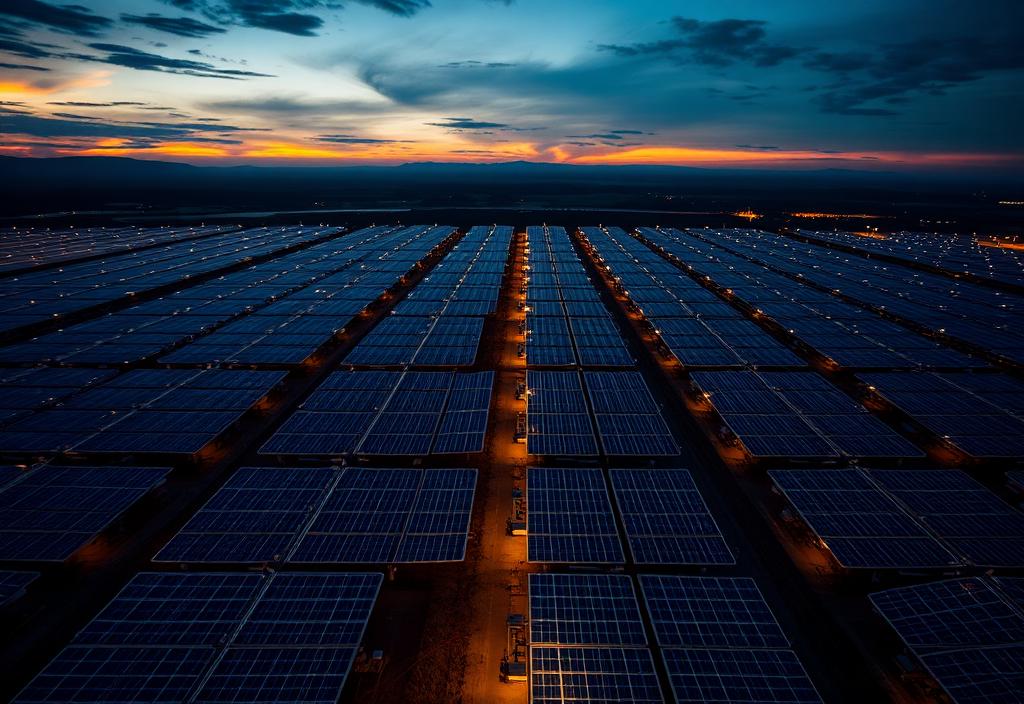
The Earth Receives 173,000 Terawatts of Solar Energy
The bottleneck has never been the fuel. It's always been the infrastructure.
Human civilization currently consumes roughly 18 terawatts of power. The sun delivers approximately 173,000 terawatts to Earth's surface, continuously, every hour of every day.
That ratio — nearly 10,000 to one — is not a curiosity. It is the defining fact of the modern energy transition. We are not running out of energy. We are running short of the infrastructure required to catch it, convert it, store it, and move it to where it needs to go.
The constraint is no longer fuel. It is engineering velocity.
A Number That Defies Intuition
173,000 terawatts is difficult to hold in the mind. Start with smaller units: a single terawatt is one trillion watts. The entire United States electric grid operates at roughly 0.45 terawatts of average load. Global civilization — all of it, every factory, data center, vehicle, and heated building — runs at approximately 18 terawatts.
The sun delivers the equivalent of global civilization's entire energy budget every 93 minutes.
For context: biological photosynthesis, the mechanism that built every forest and reef and food chain on Earth, captures approximately 140 terawatts per year. That is the energy engine behind all terrestrial life. The solar flux reaching Earth's surface is still 1,200 times larger.
This is not an argument for any particular technology or policy. It is a physical baseline. The resource is not scarce. The question is infrastructure.
"The constraint is no longer fuel. It is engineering velocity."
Solar Became Infrastructure, Not Just Energy
For most of the twentieth century, photovoltaic solar was a curiosity — expensive, low-volume, applicable mainly to satellites and remote applications where the alternative was no power at all. The economics were simply not competitive with fossil fuel generation.
That changed faster than most utility planners anticipated.
The levelized cost of energy (LCOE) from utility-scale solar has fallen more than 90 percent in the last decade. In large portions of the American Southwest, MENA region, and South Asia, solar-plus-storage is now the least-cost new generation resource on an unsubsidized basis. The technology crossed from experimental to infrastructure-grade somewhere around 2018 and has not looked back.
The defining characteristic of infrastructure-grade technology is modularity and deployment scale. A 500 MW solar facility can be designed in months, procured from a relatively standardized supply chain, and constructed in one to two years. Compare that to a new combined-cycle gas plant or nuclear unit, which require multi-year permitting, complex fuel contracts, and construction timelines that can stretch beyond a decade.
"Solar is now a construction problem."
The Real Bottlenecks
This is where the analysis gets concrete — and where most public discussion stops being useful.
§Interconnection Queues
The Federal Energy Regulatory Commission reported that the U.S. interconnection queue held more than 2,600 gigawatts of proposed generation and storage capacity as of 2024. To put that in perspective, total U.S. installed generation capacity is approximately 1,200 gigawatts. The queue is more than twice the installed base.
The overwhelming majority of that queued capacity will never be built. Historically, fewer than 25 percent of projects entering interconnection studies reach commercial operation. Projects wait three to five years for a grid study, receive interconnection cost estimates that can run into nine figures for a single project, and often find that the cost is simply not financeable.
FERC Order 2023 attempted to reform the process with a cluster-based study approach and cleaner withdrawal rules. The structural problem — too many projects chasing too little transmission capacity — is not solved by administrative reform alone.
§Transmission
The U.S. transmission system was largely designed around centralized fossil fuel generation. High-capacity solar and wind resources exist in places — the desert Southwest, the Great Plains, the offshore Atlantic — that are often far from load centers. Moving that power requires transmission.
High-voltage direct current (HVDC) transmission can move large quantities of power over long distances with lower losses than AC systems, but HVDC projects require decade-scale planning, complex multi-state permitting, and capital investment of $3 to $5 million per mile. The U.S. has added very little long-distance transmission capacity in recent decades. Grid operators in the Southwest routinely curtail solar generation — paying generators to stop producing — because there is no wire to move the power to where demand exists.
§Transformer Supply
Large power transformers are one of the less-discussed but most consequential bottlenecks in the buildout. These units, which step voltage up or down at substations and interconnection points, have lead times of 18 to 36 months from major manufacturers. Some specialized units are quoting beyond three years.
The U.S. produces a fraction of its transformer demand domestically. The supply chain runs primarily through South Korea, Germany, and increasingly India. When interconnection activity accelerates — as it has — the transformer queue lengthens. This is not a problem that capital alone solves quickly. Manufacturing capacity must be built or contracted well in advance.
§Storage Duration
Battery storage has scaled faster than almost any grid technology in history. U.S. utility-scale battery capacity roughly doubled in both 2022 and 2023. Four-hour lithium iron phosphate systems have become the dominant procurement target in competitive markets.
Four hours, however, is not seasonal storage. It is not even sufficient for multi-day grid reliability events during extreme weather. The gap between what four-hour BESS provides — diurnal shifting and capacity market participation — and what firm, dispatchable power requires is still being filled by natural gas peakers and, in some regions, pumped hydro.
Long-duration storage technologies — iron-air batteries, flow batteries, compressed air, green hydrogen — remain in the early commercial or demonstration phase. The economics are improving. The deployment scale needed to provide true grid resilience across multi-day weather events is still years away from competitive grid-scale deployment.
§Permitting
A utility-scale solar project in the U.S. can require permits and approvals from a dozen or more federal, state, and local agencies. Environmental review under NEPA, state public utility commission approval, county land use permits, and cultural resource surveys are standard. For projects requiring federal land, Bureau of Land Management review adds another layer. Total permitting timelines of four to seven years are common for large projects on contested land.
The disconnect between physical construction velocity — two solar plants can be built in the time it takes to permit one — and regulatory timelines represents a significant drag on deployment.
Why This Matters Now
The load growth story is the context that makes all of this urgent.
For the better part of two decades, U.S. electricity demand was essentially flat. Energy efficiency gains offset economic growth. Utilities planned around minimal load growth assumptions. Transmission investment was largely deferred.
That structural equilibrium is ending.
AI data centers are the leading edge of a demand surge that is unlike anything the grid has absorbed in decades. A large hyperscale data center — 500 to 1,000 megawatts — requires the equivalent of a small city's power supply, delivered continuously, with extremely high reliability requirements. Dozens of projects at this scale are in active development across Virginia, Texas, Georgia, and the Mountain West. The aggregate forecasts are striking: analysts at Goldman Sachs, Wood Mackenzie, and Grid Strategies have all published projections showing U.S. data center electricity demand growing by 50 to 100 percent before 2030.
This is not the only driver.
Electric vehicle adoption is moving EV charging load from scattered residential outlets to increasingly commercial and fleet-scale charging hubs, many of which require medium-voltage grid interconnection. Heat pumps are replacing gas furnaces at scale in new construction and retrofit markets. Reshored semiconductor fabrication, EV battery manufacturing, and aluminum smelting — all supported by recent federal industrial policy — are among the most electricity-intensive industries that exist.
The sum of these loads represents the first sustained demand inflection since the post-World War II industrial buildout. Utilities are responding: capital expenditure programs at the major investor-owned utilities are at multi-decade highs. The problem is that capital programs take time to translate into operational infrastructure, and the queue of interconnection requests is being stressed by demand-side and supply-side pressure simultaneously.
The Infrastructure Era
For most of human history, the binding constraint on civilization was energy scarcity. Wood, coal, oil, and gas were finite in accessible supply, geographically concentrated, and strategically contested. Energy was something to be discovered, extracted, and controlled.
The emerging grid is being built around a different premise.
The solar resource is not scarce. It is distributed across every latitude, available every clear day, and impossible to embargo. The constraints are not in the fuel. They are in the transformers, transmission lines, interconnection queues, permitting timelines, storage systems, and capital cycles required to connect that fuel to civilization-scale demand.
This is a different kind of energy problem than the world has ever faced. It is fundamentally an infrastructure engineering and deployment problem. The resource is abundant and getting cheaper. The question is how fast the physical systems to capture and distribute it can be built.
That answer depends less on sunlight than on permitting reform, transmission investment, transformer supply chains, grid storage deployment, and the organizational capacity of utilities and developers to execute at scale.
"The gap between those two numbers is not a resource problem. It is an infrastructure problem."
173,000 terawatts is falling on the Earth right now. Roughly 18 terawatts is being put to use.
And infrastructure problems, with sufficient capital and engineering velocity, are solvable.
The buildout, in numbers.
More than 2× the installed base — most of which will never reach commercial operation.
Solar generation paid to stop producing for lack of transmission capacity.
Specialized units now quoting beyond three years. The U.S. produces a fraction of demand domestically.
Goldman Sachs, Wood Mackenzie, and Grid Strategies converge on a multi-decade demand inflection.
More from the Feed.
Inside the Interconnection Queue Crisis
2,600 GW is waiting to plug in. Hyperscale data centers are pulling forward a transmission problem the grid was already failing to solve.
HVDC Corridors and the Stranded-Renewables Problem
Wind in the plains, solar in the desert, load on the coasts. Why long-distance transmission is the bottleneck of the decade.