
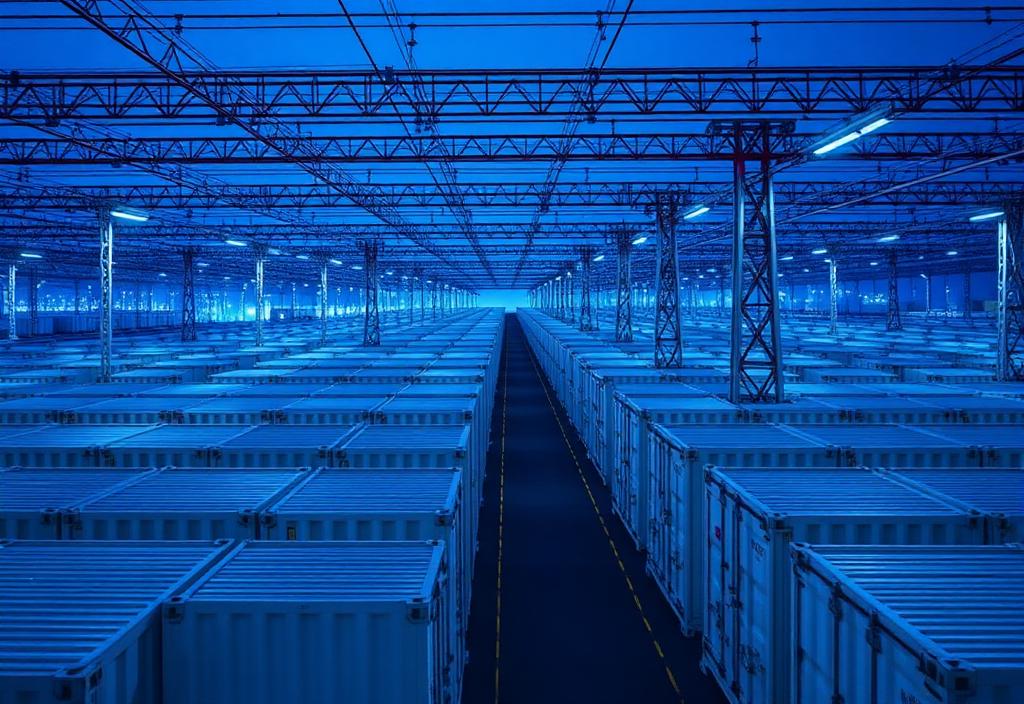
Battery Storage Is Becoming Grid Infrastructure
From peakers to firming: how 4-hour and 8-hour BESS systems are restructuring capacity markets and ancillary services.
In December 2017, a Tesla-built 100 MW lithium-ion battery system came online near Jamestown, South Australia. The Hornsdale Power Reserve was, at the time, the largest grid-connected battery in the world. It was widely covered as a stunt — a billionaire's bet, a renewable energy publicity exercise, a curiosity.
Within months, the data told a different story. Hornsdale responded to a grid frequency disturbance in 140 milliseconds — roughly 70 times faster than the coal plant that was supposed to cover the contingency. It earned its developers tens of millions of dollars in its first year through frequency control ancillary services. And it demonstrated something that grid operators had been skeptical of: that utility-scale batteries could perform reliability functions as well as, or better than, thermal generation.
What happened in South Australia did not stay in South Australia. The same economics and operational dynamics played out in California, Texas, Hawaii, the UK, and across every high-renewable grid in the world. Seven years later, the United States has more than 25 gigawatts of utility-scale battery storage installed, with that figure projected to roughly triple by the end of the decade.
Batteries are no longer a niche renewable add-on. They are becoming core grid infrastructure.
The Early Role: Frequency Regulation and Fast Response
The first utility-scale batteries were not deployed to store solar energy. They were deployed to provide frequency regulation.
Alternating current grids operate at a fixed frequency — 60 Hz in North America, 50 Hz in most of the rest of the world. When generation and load fall out of balance, frequency deviates. Too much generation and it rises; too little and it falls. Severe frequency deviations can damage equipment and, in extreme cases, trigger cascading blackouts. Grid operators maintain frequency within narrow bands through automatic generation control systems that continuously adjust output from spinning generators.
The problem is that spinning thermal generators — gas, coal, nuclear — have physical inertia and ramp limits. They cannot respond instantaneously. Early battery systems, with their near-zero response latency, could inject or absorb power in milliseconds, making them extremely effective at smoothing short-duration frequency deviations. PJM opened its frequency regulation market to storage assets in 2012, creating the first large-scale economic opportunity for grid batteries in the U.S.
The early economics were narrow. Frequency regulation markets are sized for the balancing needs of the grid, not the energy needs of the system. A 10 MW battery providing frequency regulation can earn meaningful revenues in a tight market, but the market saturates quickly. As more storage entered frequency regulation, prices fell. Early developers who built business cases around ancillary services alone found their revenues compressed within three to four years.
But the frequency regulation era did something more important than generate early project revenues. It proved to grid operators, reliability engineers, and utility procurement teams that batteries could be trusted for critical functions. That credibility opened the door to larger deployments and more complex applications.
“Batteries proved themselves on the grid the same way every other piece of infrastructure does — by performing a critical function more reliably than the alternative.”
The Economics That Made Scale Possible
The cost of lithium-ion battery cells fell approximately 97 percent between 1991 and 2024. Most of that decline occurred in the last decade, driven primarily by the electric vehicle industry.
EV manufacturing required battery packs at a scale that no grid application could have justified. Gigafactories in China, South Korea, and the United States drove cell costs from over $1,000 per kilowatt-hour to below $100 per kilowatt-hour for lithium iron phosphate chemistry. LFP, as it is abbreviated, became the dominant chemistry for stationary storage applications: it is thermally stable, long-cycling, tolerant of full-depth discharge, and does not use cobalt or nickel, which reduces both cost and supply chain risk.
Lithium-ion cost collapse
Volume-weighted average pack price, $/kWh, log scale. EV manufacturing scale and LFP adoption compressed costs by ~97% since 1991.
The inverter and power conversion system market matured alongside cell costs. String inverters and utility-scale PCS units became standardized, containerized, and increasingly commoditized. Balance-of-plant costs declined as contractors built experience across dozens of projects.
The structural shift in economics was decisive: a 4-hour, 100 MW / 400 MWh BESS system that would have cost $400 million to develop in 2015 could be built for under $150 million by 2023. In some competitive procurement regions, BESS systems became cost-competitive with new peaking combustion turbines on a levelized basis.
The Inflation Reduction Act extended the investment tax credit to standalone storage, removing the requirement that batteries be paired with solar to receive incentives. This made standalone storage projects economically viable for the first time and triggered a surge in development activity.
U.S. utility-scale battery storage growth
Installed and projected capacity, GW. The IRA inflection in 2022 reset the deployment trajectory.
At the same time, solar deployment was creating a new problem that batteries were uniquely positioned to solve.
The Duck Curve and the Operational Imperative
California built so much solar so quickly that it created a systemic operational challenge visible in every day's grid dispatch data.
The "duck curve" — named for the shape it traces on a net load graph — describes what happens when solar generation is abundant during midday hours and then drops off sharply as the sun sets. Total electricity demand does not drop at midday; in fact, the highest demand period on most days is the early evening, when people return home, run appliances, and industrial loads persist. The gap between solar generation and system load must be filled by other resources.
The deepening duck curve
CAISO net load (system demand minus solar), MW by hour of day. The midday trough deepens and the evening ramp steepens with each year of solar additions.
On a clear spring day in California, net load — total demand minus solar generation — can drop to near zero or even go negative by mid-afternoon, then ramp by 10,000 to 15,000 megawatts within a three-to-four-hour window as solar drops and evening demand peaks. That ramp rate exceeds what thermal generation alone can reliably deliver at speed. Gas peakers can ramp, but they have startup times measured in minutes to tens of minutes, fuel costs, and emission profiles that make them expensive to cycle frequently.
A four-hour battery system charging during the midday oversupply window and discharging into the evening peak is a near-perfect operational fit for this dynamic. It converts curtailed energy into peak-hour capacity. It reduces the evening ramp requirement. It defers gas peaker starts and reduces cycling wear on thermal plants that are difficult to ramp rapidly.
Evening ramp and BESS dispatch
Net load curve overlaid with BESS state-of-charge — midday charging absorbs solar oversupply; evening discharge smooths the ramp.
CAISO storage additions have tracked the duck curve's deepening almost exactly. The correlation is not coincidence. It reflects operational necessity.
“The duck curve is not an aesthetic problem. It is the operating signature of a grid that needs storage to function.”
Batteries as Grid Infrastructure
The conceptual shift — from batteries as energy storage devices to batteries as grid infrastructure — happened at the operational layer before it was recognized at the policy layer.
Grid operators began dispatching batteries not just for arbitrage but for reliability services previously provided only by thermal plants: spinning reserves, non-spinning reserves, load following, and voltage support. In markets where capacity adequacy is formalized — PJM, ISO-NE, NYISO — batteries began receiving capacity accreditation, meaning they were recognized as contributing to the region's resource adequacy margin, the reserve buffer that ensures the grid can survive unexpected outages.
Capacity accreditation for storage is technically complex. A battery provides capacity for a duration-limited window. A 200 MW / 800 MWh system provides 200 MW of capacity — but only for four hours. After that, it must recharge. Accreditation methodologies in different markets treat this duration limitation differently, and the debate over appropriate accreditation rates is ongoing. But the fundamental recognition that storage contributes to resource adequacy is now embedded in every major U.S. capacity market.
How modern BESS assets earn revenue
Stacked annual revenue mix by ISO, $/kW-yr, illustrative. Revenue stacks now combine capacity, ancillary services, and arbitrage.
Beyond capacity markets, batteries are being deployed for functions that more closely resemble transmission infrastructure than generation:
Congestion management. A BESS system placed downstream of a congested transmission corridor can charge during off-peak hours when the line is uncongested, then discharge during peak hours when congestion would otherwise restrict power flow. This defers — and in some cases eliminates — the need for expensive transmission upgrades. FERC and several ISOs are actively developing frameworks for batteries to be classified and compensated as transmission assets when they perform this function.
Transmission upgrade deferral. Utilities in distributed-load areas are deploying BESS systems at substations to defer capital-intensive transformer replacements and line upgrades. A battery that provides peak shaving at a substation can reduce peak loading on aging infrastructure, buying years of additional life for assets that would otherwise require immediate replacement. The capital economics can be compelling: a $5 to $10 million battery system deferring a $40 million substation upgrade for five to ten years is a straightforward infrastructure finance calculation.
Black start capability. Some BESS deployments are being designed with black start capability — the ability to energize a dead grid section without drawing from the transmission system. Batteries can reach full output in seconds, making them technically capable of supplying the initial power needed to restart thermal generation during a restoration sequence. Several ISOs have begun procuring black start services from storage, a function previously exclusive to large hydro and gas turbines.
Inertia substitution. As synchronous thermal generators are retired, grid inertia — the physical resistance to frequency change provided by spinning machinery — declines. Lower inertia means faster frequency deviations following disturbances. Grid-forming inverters, which can be deployed on battery systems, can provide synthetic inertia: a software-controlled response that mimics the stabilizing effect of spinning mass. This capability is still early in commercial deployment, but it is technically validated and increasingly relevant in high-renewable systems.
The operational picture that emerges is not of batteries supplementing the grid. It is of batteries becoming part of the control architecture of the grid itself.
Utility-scale BESS architecture
Power flow from cell-level chemistry to grid interconnection. Each stage is engineered as utility-grade infrastructure, not consumer electronics.
Duration Economics: From 1-Hour to 8-Hour
Early utility-scale batteries were one to two hours of storage paired with a given power rating. These were sized for frequency regulation and short-duration arbitrage — applications where high power for short periods is more valuable than sustained energy delivery.
The four-hour system became the dominant commercial configuration for a specific reason: capacity market accreditation. PJM, CAISO, and other markets developed capacity products requiring resources to demonstrate four hours of sustained output to receive full accreditation. Developers optimized their projects accordingly. The industry standardized around 4-hour lithium-ion BESS with such momentum that it effectively defined the product category.
The push toward eight-hour systems is gaining traction, driven by two converging forces: the deepening of the duck curve in high-solar markets, and the rising load profiles of AI data centers that sustain high demand through longer evening periods.
Duration vs use-case suitability
BESS duration determines which grid services a system can credibly deliver. Short durations dominate ancillary markets; long durations unlock firm capacity.
| Duration | Freq Reg | Arbitrage | Capacity | Congestion | Firm Capacity |
|---|---|---|---|---|---|
| 1-Hour | Strong | Weak | Weak | Weak | Weak |
| 2-Hour | Strong | Partial | Weak | Partial | Weak |
| 4-Hour | Partial | Strong | Strong | Strong | Partial |
| 8-Hour | Partial | Strong | Strong | Strong | Strong |
| Multi-Day | Weak | Weak | Partial | Strong | Strong |
| Seasonal | Weak | Weak | Weak | Partial | Strong |
An eight-hour system can cover the full evening peak in most markets without recharging. It can absorb a larger fraction of midday oversupply. It provides more conservative capacity accreditation calculations in duration-sensitive market rules. And as the average solar curtailment window lengthens with increased penetration, eight-hour systems can convert more of that curtailment into dispatchable capacity.
The economics of eight-hour storage are not simply twice the cost of four-hour. Cell cost is a large fraction of total project cost, so doubling energy capacity roughly doubles the battery cost. But the power electronics, inverters, site work, interconnection, and substation costs are largely fixed relative to duration. An eight-hour 200 MW system uses the same substation equipment as a four-hour system at the same power rating. Longer duration improves the ratio of energy revenue to fixed infrastructure cost.
The structural limitation of lithium-ion at longer durations is not primarily economic — it is physical. Lithium-ion cells cycle. Each charge-discharge cycle causes incremental degradation. A system cycling once per day over a 20-year project life completes 7,300 cycles. Most LFP cells are warranted for 4,000 to 6,000 cycles at depth; beyond that, capacity fade accelerates. Projects managing for 20-year economics require augmentation — adding replacement cells mid-project — which is a capital event that must be modeled carefully in project finance structures.
For seasonal storage — shifting summer solar generation to winter demand, or storing weeks of wind energy for calm periods — lithium-ion is not the right technology. The cycle economics and capital cost structures make multi-week discharge impractical. Flow batteries, iron-air systems, compressed air, and hydrogen conversion are all being developed for longer-duration applications. All remain in early commercial or demonstration stages. The technology is real; the deployment scale is not yet competitive.
The practical conclusion is straightforward: lithium-ion four-hour and eight-hour BESS systems work extremely well for daily cycling applications in high-solar markets. For applications requiring multiple days of storage or seasonal balancing, the grid will need a different technology that does not yet exist at commercial scale.
AI Load Growth and the New Procurement Cycle
The relationship between battery storage and AI infrastructure is not primarily philosophical. It is about grid reliability under accelerating load.
Hyperscale data centers operate at continuous load factors of 80 to 95 percent. A 500 MW data center draws 500 MW around the clock, 8,760 hours per year. That demand profile is unlike residential or commercial load, which peaks sharply during certain hours and drops at night. It is more similar to the demand profile of heavy industrial facilities — constant, high-magnitude, and intolerant of interruption.
Utilities planning to serve hyperscale data centers are revising load forecasts, accelerating transmission upgrade programs, and confronting the reality that the generating resources to serve this load must be both sufficient in aggregate capacity and reliable at the individual site level. Data centers require N-1 or N-2 reliability standards — they expect the grid to remain operable through the loss of any single element.
Battery storage is increasingly specified as a component of the reliability package for large data center interconnections. A substation serving a 500 MW campus may include 200 to 400 MWh of co-located BESS to provide ride-through during switching events, protection against brief outages during contingency conditions, and local frequency support during disturbances. This is not backup power in the traditional sense. It is grid interface infrastructure.
Beyond the data center connection point, battery deployments across the broader grid reduce the congestion and instability risks that would otherwise propagate to large load centers. A BESS system providing congestion management 50 miles upstream of a major substation indirectly improves reliability for every load it serves, including hyperscale facilities.
The procurement cycle has accelerated accordingly. Large utilities in Virginia, Texas, Georgia, and Arizona — the primary hyperscale corridor — are procuring storage at a pace not seen outside of California. MISO and PJM interconnection queues show large BESS projects queued alongside the solar and gas resources that will serve rising load. Storage is no longer a separate procurement category. It is part of the infrastructure bundle.
The Physical Infrastructure Reality
A utility-scale battery installation is not a warehouse of cells. It is a complex power system requiring the same engineering rigor as any other grid asset.
The dominant architecture is containerized: battery modules in standard 20- or 40-foot steel enclosures, pre-wired and factory-tested before shipment. Each container holds hundreds of battery racks, a battery management system that monitors individual cell voltages and temperatures, and thermal management equipment — typically liquid cooling — to keep cells within their operating temperature range.
Containers connect to power conversion system (PCS) units, which handle the DC-to-AC inversion, frequency regulation response, and grid interconnection logic. PCS units are themselves sophisticated power electronics systems with protective relay functions, communication interfaces, and control software that must be integrated with the ISO's automatic generation control systems and the utility's SCADA network.
Multiple containers and PCS units connect to a medium-voltage collection system and then to a step-up transformer that interfaces with the high-voltage substation. The substation includes protection equipment — breakers, relays, surge arresters — that must be engineered to the utility's interconnection standards and coordinated with adjacent transmission protection systems.
Fire suppression is a major engineering consideration. Lithium-ion cells can experience thermal runaway — an exothermic reaction that, once initiated in a cell, can propagate to adjacent cells and containers. Post-fire analysis of BESS incidents has driven significant design improvements over the past five years.
Commissioning a utility-scale BESS is a multi-month process. Containers are energized in sequence. Battery management systems are calibrated against measured cell characteristics. PCS units are tested against grid protection scenarios. Communication systems are verified against ISO data exchange protocols. Capacity testing — discharging the system at rated power for the full rated duration — is required before commercial operation. This testing and commissioning process requires close coordination with the utility and ISO, involves scheduled outages, and often reveals integration issues that add weeks to the schedule.
Augmentation is the lifecycle cost variable that distinguishes experienced BESS operators from those who modeled only initial capital. Cell degradation over time is predictable but not linear. At some point during the project life — often years 7 to 12 for daily-cycling systems — capacity falls below contract minimums, and replacement cells must be added. The augmentation scope, cost, and schedule must be modeled in the project's financial structure from the outset; discovering it mid-project creates significant financial risk.
The Limitations
A balanced analysis requires directness about where battery storage does not solve the problem.
Duration. Four-hour and eight-hour systems manage daily cycling well. They do not provide seasonal storage. A high-renewable system that has covered its daily flexibility needs with lithium-ion still requires firm dispatchable generation — gas, nuclear, hydro, or future long-duration storage — to maintain reliability through multi-day calm weather events, seasonal demand peaks, and regional weather extremes.
Degradation. Batteries wear out. The degradation curve is predictable, but it means that a 200 MW system contracted for 20 years needs augmentation capital that must be financed and executed. Projects that have been structured without adequate augmentation reserves are a growing financial risk category in the storage sector.
Thermal runaway. The fire risk in BESS deployments is real, has caused multi-million-dollar losses in several high-profile incidents, and has driven insurance premiums higher across the industry. Design standards have improved significantly, but the risk profile of lithium-ion storage differs meaningfully from that of other grid assets and requires specialized operator training, site planning, and emergency response coordination.
Mineral supply chains. LFP cells do not require cobalt or nickel, which reduces supply chain risk compared to earlier lithium-ion chemistries. But lithium itself, along with manganese and iron, must be mined, processed, and refined. The supply chain for battery-grade lithium remains concentrated in a small number of geographies, and long-term supply security is an active planning concern for large-scale deployment.
Transmission dependence. A battery system can only dispatch energy to where transmission allows it to flow. A BESS located on the wrong side of a congested transmission corridor — unable to reach load centers during peak periods — provides limited operational value regardless of its technical specifications. Storage does not substitute for transmission. It is a complement to it.
“Storage does not substitute for transmission. It is a complement to it.”
The Bigger Picture
The grid is transitioning from a system organized around centralized, scheduled generation to a system organized around continuous, dynamic infrastructure coordination.
In the old model, a small number of large generators dispatched in merit order provided virtually all reliability services. Frequency regulation came from spinning reserves on thermal generators. Voltage support came from synchronous machines. Capacity adequacy came from large plants with predictable output.
In the emerging model, reliability services are provided by a larger number of smaller, faster assets distributed across the network. Batteries provide frequency regulation in milliseconds. Grid-forming inverters provide synthetic inertia. Distributed energy resources respond to dynamic price signals. The control layer is software-defined and increasingly automated.
Battery systems are becoming the connective tissue of this new grid architecture. They sit between intermittent generation and continuous demand, absorbing variability, delivering flexibility, and providing the fast-response reliability services that thermal generation provided through physical inertia.
This is not a speculative future state. It is the operational reality in California, Hawaii, the UK, Australia, and increasingly in Texas and the Mid-Atlantic. The dispatch curves, the ancillary service market data, and the reliability event records all show batteries performing functions that were exclusively thermal a decade ago.
The transition is not complete. The grid still depends heavily on gas peakers for firm capacity during extended low-renewable periods. The long-duration storage gap is real and unsolved at commercial scale. The transmission buildout needed to fully integrate high-renewable systems with distributed storage is years behind where it needs to be.
But the direction is established. The technology is proven. The economics are compelling. And the operational need — driven by renewable penetration, AI load growth, and grid complexity — continues to grow faster than any single generation technology can address.
Conclusion
Battery storage entered the grid as a frequency regulation asset. It stayed because the grid needed flexibility that thermal generation alone could not provide. It is now being deployed as reliability infrastructure, capacity market resource, transmission deferral tool, and grid control asset.
The Hornsdale Power Reserve in South Australia was called a stunt. The 25 gigawatts of utility-scale storage now online in the United States is called routine. The 75 gigawatts projected by 2030 will be called essential.
Battery storage is no longer experimental. It is not a renewable energy talking point. It is infrastructure — physical, engineered, financed, and increasingly indispensable to the operation of grids that are simultaneously absorbing more renewable generation and serving more demanding load.
The grid increasingly depends on storage not because of ideology, but because the operational requirements of high-renewable systems with AI load growth, congestion, and electrification require fast, flexible, duration-capable infrastructure that thermal generation alone cannot provide at competitive cost.
The question is no longer whether batteries belong in the grid.
The question is how fast they can be built, interconnected, and deployed at the scale the grid now requires.
The infrastructure layer, in numbers.
Installed U.S. utility-scale battery capacity, up from under 1 GW in 2018.
Tripling within five years, driven by capacity markets, AI load, and IRA standalone storage credits.
Disturbance response time — roughly 70× faster than the coal plant covering the contingency.
Cell cost reduction since 1991, with most of the curve compressed into the last decade.
More from the Feed.
The Earth Receives 173,000 Terawatts of Solar Energy
The bottleneck has never been the fuel. It's always been the infrastructure.
Inside the Interconnection Queue Crisis
2,600 GW is waiting to plug in. Hyperscale data centers are accelerating a transmission problem.
HVDC Corridors and the Stranded-Renewables Problem
Wind in the plains, solar in the desert, load on the coasts. Why long-distance transmission is the bottleneck of the decade.